

Vietnamese cuisine
"If modern Vietnamese food had a voice, it would be bilingual, for it is the offspring of a marriage of convenience between a rice-based diet and a wheat-based culture"
Like any other offspring in this world, Vietnamese cuisine might have “inherited” some features from its “parents” – Chinese and French colonists - but under the impact of environmental factors and the creativity of Vietnamese, it flourishes on its own, becoming something unique and single-handedly making its mark in this world. When discussing Vietnamese cuisine, there are three keywords that are mainly mentioned: rice, Chinese and French, which are all reflected in the recipes included in this cookbook. However, what the authors did differently in this book is clarify the uniqueness of Vietnamese cuisine thanks to its combination of flavors instead of reinforcing the public’s opinion that Vietnamese cuisine is similar to that of Chinese. As the author said: “Anyone under the illusion that Vietnamese cookery is a mere variation of Chinese cuisine will discover what a fundamental style it has and an unforgettably different delight it is.” (Ngo, Zimmerman 3)

When “The classic cuisine of Vietnam” by author Bach Ngo was published in 1979, unlike the Vietnamese community, the Chinese community had been quite established in the U.S. with a population of more than 800.000 Chinese Americans in 1980 (Gardner 5). Therefore, Chinese cuisine had been around in the U.S. for a while before the Vietnamese immigrants arrived and brought along their food. Therefore, before the publishing of this book, there existed a misconception among Westerners that Vietnamese cuisine is similar to dishes from other Asian cuisines like Chinese or Japanese. This misconception was indeed mentioned in an article published in 1979 in the New York Times by Jacques Penn: “For many Westerners, oriental cooking means Chinese or Japanese food. It is a self-imposed limit with shortcomings that are apparent at the first taste of Vietnamese cuisine. The food of Vietnam is unlike any other oriental food. It is distinctive in its seasonings, its basic ingredients and its method of cooking. And it is little known in New York City, where the Vietnamese community is as yet quite small.”
The difference in how Vietnamese food was approached before and after the mass arrival of Vietnamese immigrants to the US after 1975 can be observed through comparison with a book published in 1960 in New York called “The Complete Book of Oriental Cooking” by Myra Wyldo. The book claims to include 350 “wonderful” recipes from the “Far East” which group Hawaiian and several Asian countries like Vietnam, Malaysia, Japan, China, etc. in the same category of “Oriental” and “exotic” cooking. During this time, one of the two Vietnamese recipes included in this book – “Beef Noodle Soup – Pho” was put into the group “Indochina” along with Laos and Cambodia. It should also be noted that at this time, Vietnam was still referred to as “North Vietnam” and “South Vietnam” due to the The Vietnam War also known as The Second Indochina War happening from 1955 to 1975, when the North and South of Vietnam was still divided. As seen in Appendix 4, the recipe of Pho in this book is completely different from that of The Classic Cuisine of Vietnam and bore zero resemblance to how Phở is cooked in Vietnam nowadays. Also, Vietnamese ingredients were spelled incorrectly. Therefore, Bach Ngo and Gloria Zimmerman’s Vietnamese cookbook definitely did a great job in clarifying the distinction of Vietnamese cuisine from that of Chinese, its uniqueness and at the same time reinforcing the position of Vietnamese food in foreigners’ perception.
Rice in Vietnamese cuisine
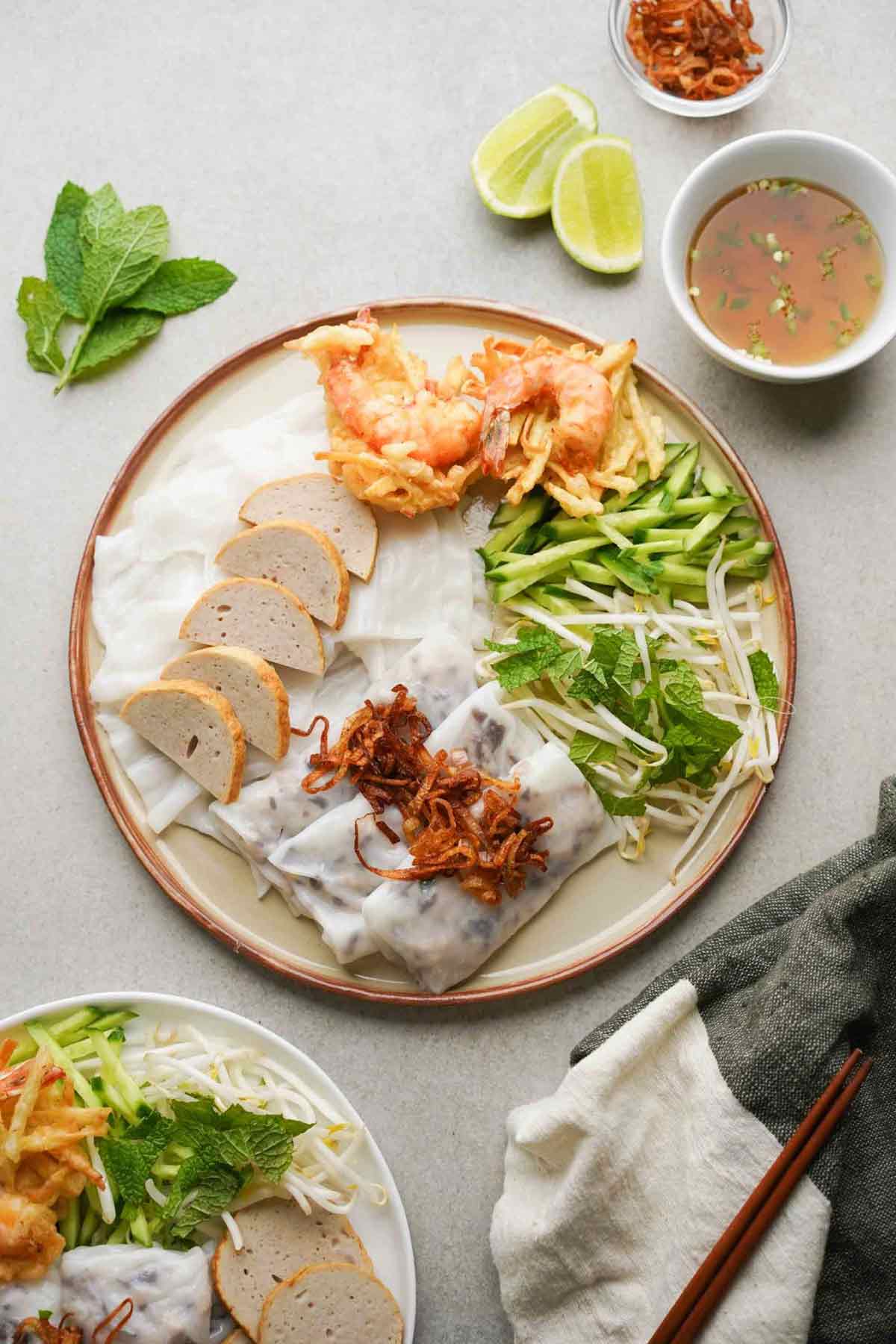
Rice appears in different forms in several Vietnamese recipes like Phở (Beef Hanoi Soup) with rice noodles, Bánh Chưng (Vietnamese New Year Cakes) with glutinous rice, Barbecued Beef (thịt nướng) with Fresh Rice Paper (Bánh ướt) or with rice vermicelli (bún), rice cakes (Bánh Khoái), Pancake (Bánh xèo) and Rolling Cake (Bánh Cuốn). As a Vietnamese saying goes, “Not eating rice with a meal means we have not eaten” (Lien 11), implying that rice is a staple food in Vietnamese diet. Not only does it appear in different forms, ranging from the shape of grains, noodles, sheets to flour, but the rice itself also has numerous varieties to choose from. Depending on your budget, you can find rice in all categories of quality.
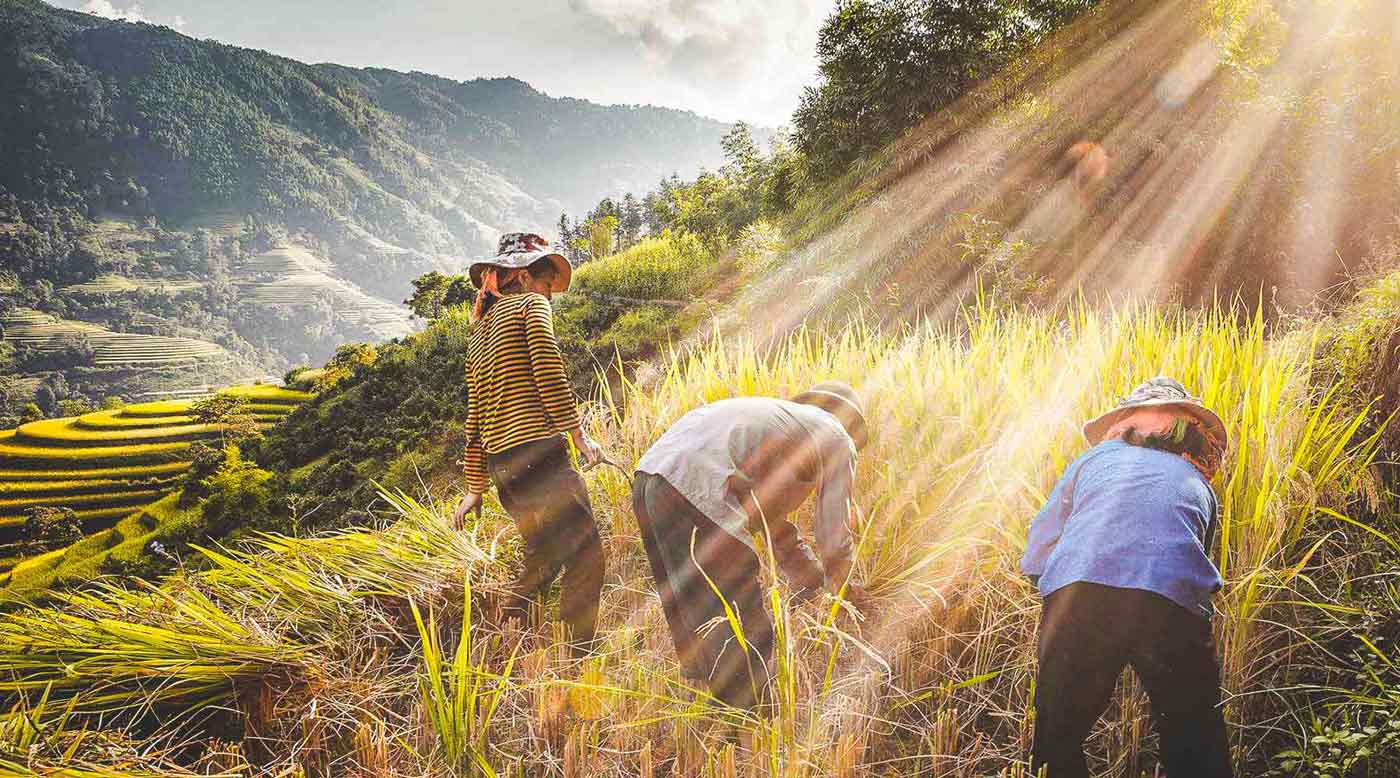
Speaking of the origin of rice in Vietnam, it is still a question for discussion whether rice was introduced to Vietnam by Chinese or Vietnam first cultivated and domesticated rice ourselves. According to findings in some areas in the Red River Delta in Vietnam, the first rice agriculturalist in Vietnam could have been dated back to 2000 BCE. As stated in The Cambridge World History of Food (Lien 11), “Initial selection and cultivation could have occured independently and nealy concurrently at numerous sites within or bordering a broad belt of primary genetic diversity that extends from the Ganges plains below the eastern foodhills of Himalaya, through upper Burma, northern Thailand, Laos, and northern Vietnam, to southswest and southern China” . Based on this statement, it can be concluded that whether rice was domesticated by Vietnamese or was imported, it was indeed still cultivated in the Red Rive Delta during the aforementioned timeline, becoming a part of Vietnamese meals and remaining a staple food in Vietnamese diet since then.
After Vietnam won the Vietnam War in 1975 and unified the South and the North, the country went through an economic crisis due the integration of two different economic systems from the North and the South, known as the Subsidy Period (Thời kì bao cấp) taking place from 1975 to 1986. Households in both the South and North participated in a food-rational system, in which each household was allowed to buy a limited amount of low-quality mixed rice along with some other food commodities with stamps and coupons provided by the government. Low-quality wheat flour and noodles were also available during this time. However, at this point, rice had become an essential part of the Vietnamese diet, so wheat flour and noodles were not in demand, so instead they became products that Vietnamese used to trade for rice. By the end of the 70s, rice and other food commodities were sold in black market and caused serious economic inflation. Ineffective policies, food shortage and extreme living conditions drove many Vietnamese to find a way to migrate to the U.S. with the hope for a better life. Only until 1986, with the new government and market reforms known as Đổi Mới (Revolution), the situation got better and the food production picked up, rice continued to be a staple food in Vietnamese diet and became one of the top export products in Vietnam.
References
Ngo, Bach, Gloria Zimmerman, and Bach Ngo. classic cuisine of Vietnam. Barron's, 1979.
Wieder, Rosalie. "Vietnamese American". In Reference Library of Asian America, vol I, edited by Susan Gall and Irene Natividad, 165-173. Detroit: Gale Research Inc., 1996.
Iverson, et al. “Bach Ngo - From Nha Trang to Connecticut Classic Cuisine of Vietnam.” Pacific Rim Gourmet, 17 July 2013, impexco.org/?p=4223.
Penn, Jacques. “Vietnam's Distinctive Food.” The New York Times, The New York Times, 7 Nov. 1979, www.nytimes.com/1979/11/07/archives/vietnams-distinctive-food-the-distinctive-cuisine-of-the-vietnamese.php.
Claiborne, Craig. “VIETNAMESE RESTAURANTS: ROOM TO GROW.” The New York Times, The New York Times, 4 June 1986, www.nytimes.com/1986/06/04/garden/vietnamese-restaurants-room-to-grow.php.
Lien, Vu Hong.”Rice and baguette: a history of food in Vietnam.” Reaktion Books, 2016.
Waldo, Myra. “The Complete Book of Oriental Cooking”, Bantam Books, 1965, p. 159.
Huynh, Cuong. “Pho in the U.S.: Sweeping North America Since 1975.” Vietnamese Pho and Pho Restaurant Business, 25 Mar. 2020, www.lovingpho.com/pho-opinion-editorial/pho-sweeping-usa-north-america-since-1975/.
Gardner, R W et al. “Asian Americans: growth, change, and diversity.” Population bulletin vol. 40,4 (1985): 2-44.